Overview
The content of this page is intended to give individuals and groups an overview of 40 key concerns regarding Southern Water’s revised draft WRMP which is available for consultation until 4 December 2024. The points have been highlighted by a concerned retired water industry expert within the ‘Water Matters’ group and will help you to pin-point key information of concern within the vast volume of consultation reports and appendices.
The government (DEFRA) rejected the previous Southern Water (SW) draft WRMP in 2023 following public objections and concerns expressed by regulators. It is very disappointing that the Company has not taken the opportunity to start again, undertake a more realistic review of the water resources position going forward, and a more robust evaluation of potential solutions to bring forward a more sustainable plan.
Instead, the plan focuses on how SW can fill the supply deficit in a drought before the previously selected effluent recycling schemes are due to come on stream. The Hampshire effluent recycling scheme (using Havant Thicket Reservoir as an environmental buffer) is proposed to be available in 2035, but it will ultimately transfer recycled water via long pipelines that have to operate everyday (not just in a drought) to Otterbourne (near Winchester, Southampton and the Isle of Wight) and West Sussex. Portsmouth Water customers will also receive the recycled effluent to their taps when the reservoir is used, initially in a drought or emergency, but from 2040 more routinely.
Sadly, the Company have come back with the same plan to treat and recycle the final effluent from sewage works in Hampshire, the Isle of Wight and West Sussex, putting ‘all their eggs in one basket’, which if it fails leaves no solution for our rivers. Planning to operate these schemes 365 days in a ‘normal year’ (no drought) at a huge carbon and energy cost of £3 million pounds a year just for the Hampshire scheme. If the revised draft plan is approved by DEFRA then the need for effluent recycling will be accepted at a national level, and Southern Water can then push full steam ahead with all these schemes, instead of developing more sustainable alternatives. After that it will be almost impossible to stop the individual effluent recycling schemes.
Just to prove they have no environmental credentials Southern Water leave DEFRA & the regulators with the stark choice of either tankering water from Norway in a drought, which is unsustainable and puts the River Test at risk, or allowing them to continue to use drought permits on our precious chalk streams, while they continue to abstract and ‘just wait in hope’ that they can get permission to build the effluent recycling plants for which costs are spiralling.
This cannot provide ‘best value’ for customers or the environment, when more sustainable schemes could be brought forward as part of the plan.
DEFRA are the only ones that can stop this plan going ahead. We need everyone concerned about the revised plan, who wants Southern Water to develop more sustainable solutions that work with climate change, to object to the plan by emailing DEFRA to explain their concerns.
Note: The complete set of Southern Water consultation reports and appendices, together with a downloadable PDF formatted version of the contents of this web page which some readers may find provides a useful companion when writing their response to the consultation. These documents can be accessed at bottom of this page. Go straight there with this link.
40 concerns that must be explored by DEFRA’s review of Southern Water’s latest 2024 Draft WRMP
Concerning Southern Water’s latest Draft Plan
1
The plan does not strive to work with predicted changes to our climate to capture more winter rain for use in dry summers. Rainwater provides a good quality free raw water resource and we need to prioritise schemes that capture and store it for dry summers. (For further detail refer to item A below).
2
SW have not completed a full review of the plan considering all alternative options as “a full re-appraisal exercise was not considered time or cost beneficial” (Annex 20, page 3). Given the importance of finding immediate solutions for the rivers Test and Itchen and at Pulborough, along with the large volume of objections to the options selected in the previous draft plan, a full and more robust review was essential. More sustainable options previously ‘parked’ by SW which work with predicted climate changes should have been more robustly assessed and included in the revised draft plan.
3
It is clear that SW have only focused on identifying options to fill the gap as a result of the delay to recycling options in Hampshire and at Littlehampton (Annex 20, page 1 and 3) instead of seriously looking at prioritising more sustainable options.
4
The timescales for delivery of effluent recycling options are unrealistic given their complexity and consenting requirements. Having put back the delivery year for the Hampshire effluent recycling scheme to 2034-35 in the Statement of Response, in places in the latest plan this option has now been brought forward to 2033-34. This is not realistic given the public opposition, risk of an enquiry, risks associated with bringing forward technology which is new to the UK for effluent recycling, and developing on old landfill sites, the recycling options are much more likely to be delayed further, leaving our precious and iconic chalk rivers with no solution for longer.
5
SW proposal to continue to rely on and extend the use of the Candover Drought Option (augmentation boreholes) and drought permits (Technical Report page 138-139) should not be permitted beyond 2030. The plan extends their use up to 2034. (For more detail refer to item B below.)
6
SW should not be allowed to rely on continued use of the Candover drought option, Lower Itchen and Test drought orders, while they just wait for the Hampshire effluent recycling/ transfer scheme to be delivered as proposed (Annex 20, page 1 and 2), as it is inevitable that the Hampshire recycling scheme will be delayed further and will not be available in 2035, a more sustainable solution must be developed.
7
Tankering water from Norway in a drought cannot be accepted as a credible drought plan. (For more detail refer to item C below).
8
SW are unnecessarily pessimistic in their assumptions regarding population growth and this is driving a large demand deficit. The information provided is also contradictory with Annex 7b forecasting 23% growth and Annex 14 referring to a 17% increase by 2050. Surely that level of population growth is not credible. (For more detail refer to item D below.)
9
Assuming high levels of abstraction reform is over precautionary when what will be required in future is currently very uncertain as SW environmental studies are still ongoing. This is driving a large demand deficit which helps SW justify their unsustainable effluent recycling schemes. (For more detail refer to item D below.)
Assuming no abstraction at all even in winter from the rivers Itchen and Rother is not appropriate and over precautionary. (For more detail refer to item E below.)
10
SW lose 100 million litres of water every day to leaks, that is 19% of all the water they abstract from the environment, which customers pay to treat, wasted through leakage in their distribution system. Yet their slow programme for improvements means even by 2050 they will still be leaking about 10% of all the water they treat, including the new water manufactured at huge cost from their planned new effluent recycling schemes. Without a more ambitious mains replacement programme they will never get leakage under control.
An industry leakage specialist tells us that if Southern Water prioritised and funded leakage reduction they could strive to achieve a 50% reduction by 2040 and a 70% reduction by 2050, rather than the 53% leakage reduction target they have set themselves by 2050.
Government figures indicate that Southern Water lose a further 3.2% of the water they take from the environment before it even reaches a treatment works. This shows a complete disregard by the company for just how precious water is.
11
SW have not taken account of the completion of the Hampshire Grid improvement programme which will be available from 2030 to rezone the Western supply area. The Company option review and selection process is based on individual supply zones. Taking account of the increased ability to transfer water within Hampshire by merging existing zones could have changed the options appraisal process. As the plan does mostly cover the period beyond 2030 the improved connectivity of the grid in the Western Area supply area by 2030 should have been fully considered and taken into account in the plan.
(For more detail refer to item F below.)
12
The investment model is not fit for purpose it needs to be urgently revised so that it does not preferentially select the use of drought options/permits. The model needs to be able to preferentially select smaller more sustainable options, whereas it currently favours large infrastructure schemes which should be a last resort once more sustainable options have been exhausted. (For more detail refer to items K and L below.)
13
The possibility of market trading for ‘water credits’ is mentioned. This is a concern as it could create a new loophole for water companies and speculative developers to exploit to make money, while not actually doing anything to fix the problems faced.
14
Given spiralling costs, programme delays, significant environmental effects, the need to operate 365 days a year, lack of legacy and short life-span, the Hampshire effluent recycling scheme cannot represent best value for customers. In fact, the restricted documents confirm that the Hampshire effluent recycling/ transfer scheme is almost as expensive to operate (OPEX) per megalitre as tankering water in from Norway!
15
The selection of effluent recycling via Havant Thicket and transfer (40km) to Otterbourne results in unacceptably high carbon impact and greenhouse gas emissions, more than double that of any other transfer or desalination scheme. In fact, the restricted documents confirmed that the Hampshire effluent recycling/ transfer scheme has a higher total carbon, average carbon emissions & embedded carbon impact than sea tankering water in from Norway! (For more detail refer to item M below.)
16
SW Preliminary Environmental Information Report (2024) confirmed a likely significant effect on the marine environment from the Hampshire effluent recycling scheme. Modelling for water quality impacts on the reservoir is still not available. The scheme should not move forward until the environmental risks/impacts are known.
17
The process of environmental assessment and screening methodology cannot be robust if unsustainable and environmentally damaging schemes like the Hampshire effluent recycling/transfer scheme get through. In fact, the Strategic Environmental Assessment confirmed that the Littlehampton Effluent Recycling scheme and Hampshire effluent recycling scheme had the highest negative impact scores, yet both of these options were selected by Southern Water.
18
This is a short-sighted water resource plan, customers will still be paying for the effluent recycling infrastructure after it has become redundant due to the Ofwat funding mechanism. With the recycling plants expected to last just 60 years, the huge cost of constructing these schemes cannot be justified, especially as these options leave no tangible legacy for the future. The Hampshire effluent recycling / transfer scheme alone will cost at least £1.2 billion. Customers will also have to pay for the eye-watering debt generated well into the future.
For more information on the key concerns and environmental impacts associated with the Hampshire effluent recycling scheme via Havant Thicket Reservoir please refer to ‘Effluent Recycling – the 15 Key Concerns’.
Concerning option selection
19
Moving the Otterbourne abstraction to the tidal limit would be a better, more robust and sustainable solution to protect the whole of the freshwater catchment and restore natural flows in a drought. This is not mentioned as an option that has been considered in the SW Technical Report, nor Annex 20. (For more detail refer to item E below)
20
In the future SW indicate they will work with stakeholders to look at moving the abstraction on the River Adur to the estuary (transitional waters) to allow more abstraction (Annex 20, page 30-31) but this is not in the current plan. Moving river abstractions to the tidal limit can have environmental benefits, restoring more natural freshwater flows in rivers to protect the ecology. This scheme should be selected now and prioritised as a more sustainable solution. (Why is the solution of moving abstractions to the lower catchment of rivers not being prioritised for investigation as a more sustainable solution across the region?)
21
More challenging targets must be set for delivery of the groundwater borehole schemes and Test Managed Aquifer Recharge Scheme in Hampshire, as they require minimum infrastructure and are within the company’s control. Investigation and delivery should commence in 2025 to ensure these schemes are delivered as quickly as possible, to provide at least 13.8 Ml/d to help better manage resources in the catchments and protect the rivers Test and Itchen from drought orders. We need Defra and the regulators to strongly challenge on this to ensure a quicker delivery date. (For more detail refer to item H below.)
22
The investigation of other aquifer storage schemes in Hampshire, the IOW and West Sussex is not being prioritised to establish the yield they could provide. This is essential and should be prioritised and funded urgently so that these schemes can be included as feasible options. Aquifer storage has been successfully used for many years across the world, including in California and in the Thames Basin (UK). Tests in Dorset have previously shown that aquifer storage and recovery is feasible in confined sections of the chalk.
(For more detail refer to item G below.)
23
Proposed schemes to recycle water currently wasted at the Otterbourne and Testwood Water Treatment Works should be prioritised more urgently to help minimise abstraction on the Test and Itchen all the time, not only in a drought (Annex 20, page 32).
24
No work is taking place to ensure the alternative Hampshire effluent recycling option using Peel Common and a bespoke environmental buffer lake are advanced as a back-up, despite this work having been allocated funding by Ofwat. Nor is there any reference to further investigation of a combined Portswood and Peel Common scheme. A scheme previously indicated to be feasible with sites that are closer to where the water is needed. (For more detail refer to item J below.)
25
Negotiations with a very large industrial water user in South Hampshire should have been brought forward as a priority, to explore alternative supply options when the contract expires in 2026, to free up drinking water for SW customers in a drought (Annex 20, page 6) and provide more certainty for the plan.
Could a desalination plant that trials research into alternative technology, potential uses for the hyper saline solution and reducing energy consumption be a way forward for this site (Annex 20, page 30 refers) perhaps in partnership with industry.
26
In West Sussex the need for network upgrades is being used as an excuse not to bring forward schemes at existing works that would increase supply (Annex 20, Appendix A). If all of these schemes rejected for this reason were brought forward, they could deliver more than 20Ml/d of water to the Central Region. This is more water than is to be provided by the proposed Littlehampton (Ford) effluent recycling scheme which will discharge to the Western Rother. The necessary network upgrades in West Sussex should form part of the plan. Network upgrades are taking place in Hampshire to address such concerns, why not in West Sussex?
27
Across the Western and Central Area the fact that sources ‘might not be available in a drought’ is being used by SW as an excuse not to increase capacity at existing water treatment works. If the works were upgraded they could be used at higher capacity during normal operation, leaving other groundwater sources that would be available in a drought to rest or be used less, so that more groundwater is available in a drought. Schemes to increase capacity at existing works could deliver 18 Ml/d of water across the region and these options should be prioritised. However, SW are less likely to find this an attractive option where the source is surface water because it is cheaper to treat and supply groundwater every day. SW need to plan to use their water sources in a more sustainable way that works with climate change, not just use the cheapest sources first.
28
Multiple cheaper and more sustainable schemes have been rejected by SW because they ‘cannot be delivered in time’ (presumably this means by 2030).
17 schemes in Hampshire and IOW (Western Area) could deliver at least 42 Ml/d.
7 schemes in West Sussex (Central Area) could deliver at least 18 Ml/d
Yet the effluent recycling scheme in Hampshire which will supply both Hampshire and West Sussex cannot be delivered until 2035 either, and that timescale will almost certainly slip further. SW are putting all of their ‘eggs in one basket’. Surely it is better, more resilient and more sustainable to develop multiple smaller schemes, close to where the water is needed, many of which do not even require new consents, just treatment plant or borehole upgrades.
29
SW are still not urgently investigating and bringing forward additional new reservoir schemes in the short to medium term, despite this being customers preferred choice. The delivery of the River Adur project is not scheduled until 2045/46, no other reservoir schemes are in the pipeline in Hampshire or West Sussex in the revised draft plan.
30
Groundwater schemes on the Isle of Wight (IOW) are not brought forward as the water gained cannot be transferred to the mainland to help the rivers Test and Itchen in a drought (Annex 20, page 5-6). However, if implemented they would reduce the amount of water that needs to be transferred from Southampton to the IOW providing a benefit that should be pursued.
31
The timescale for delivery of ten years should not be seen as a valid reason to reject provision of a bi-directional link between the IOW and the mainland, especially as it could allow water to be used more flexibly in a drought, including use of future spare water from Sandown.
32
There has been little proactive work by SW to investigate buying or trading licences with private supply users across the region. In a restricted document supporting the previous draft plan it indicated buying just one licence could deliver 19.7 Ml/d. There should be more proactive investigation and negotiation by SW to buy existing private abstraction licences, this in turn would then open up the potential for a more flexible approach to the use of licences within a catchment to meet water supply needs and environmental objectives.
33
Much more effort needs to be put into working with industry, agriculture, golf courses and community buildings (schools, social clubs and so on) to fix leaks, save water and reduce their use of drinking water for non-potable uses. Southern Water pilots have already demonstrated that great reductions can be achieved with free surveys and provision of grants to encourage the adoption of more sustainable solutions. Yet their targets for improvement in the first 10 years of the plan are woeful, with no benefit by 2030, and hardly any by 2035 (Annex 14, Table 15).
34
The free water butt scheme trialled on the IOW should be rolled out across the SW supply area to customers as a priority.
35
To read about a strategy for a better way forward please refer to the Water Matters page on ‘A better way forward’ at this link.
Concerning inadequate consultation with water users and affected communities
36
Critical documents to understanding and evaluating the options available have not been made available to the public. Instead, SW have classified the Options Appraisal and key environmental assessment reports as restricted. In fact there are more documents restricted in 2024, than there were in 2022. Is this a deliberate play to hide important information? As SW know it is unlikely that customers will be prepared to travel to their Worthing HQ to view these large reports that cannot be properly reviewed in one visit. Other water companies made this information more accessible.
37
Customer research across the water industry has shown a clear preference for more natural solutions such as aquifer storage, reservoirs and catchment management. Why are SW not listening to their customers and instead pushing ahead with the least favoured options of desalination and effluent recycling?
38
Assurances given by SW that water quality modelling and energy use information for the Hampshire effluent recycling scheme would be available in time for the 2024 consultation have not been met.
39
Lack of adequate and meaningful engagement /consultation with customers;
– A very significant alteration is taking place to customer’s water supply with the source changing from river, spring or groundwater to recycled effluent. SW should be proactively engaging with all their customers to get their feedback on this material change.
– SW did not follow the legal requirement for a new statutory consultation on their plan when there was a material change to the option(s) selected in 2021, when the Fawley desalination scheme was rejected, and the WRMP19 back-up option of discharging recycled effluent to the River Itchen was also rejected. When there was a material change to the plan in 2021 SW should have undertaken a comprehensive review of all the available options and a full public consultation. This did not happen.
– As a result, communities in the areas affected by the selected options did not have the opportunity to comment at the ‘formative stage’ of the plan, before the new effluent recycling options were selected.
– At the time of previous consultations (2020 to 2022) posters were not even placed at sites impacted to make local communities aware that a consultation was taking place. Nor have posters been placed at impacted sites for this Autumn 2024 consultation.
40
The consultation documents are vast, very repetitive and fail to provide important information, or make it restricted and inaccessible, making it very difficult for a lay person to understand/get through the consultation reports. Is this intentional?
Since this is a ‘once-in-a-generation’ chance to address future water needs, there needs to be a more open discussion about moving to a more sustainable approach which works with predicted climate change, not against it.
Further Detail
More detail on some of these concerns is set out below with page numbers provided to help find the relevant detail in the SW consultation Technical Report.
A
The SW revised draft plan does not strive to work with predicted changes to our climate, which modelling has shown means we will get wetter winters and drier summers. We need a complete re-think about how, where and when we take water from the environment.
We need a strategy that includes;
- Moving abstractions (river and boreholes) to the bottom of the catchments,
- Collecting more water in winter and storing it for use in dry summers.
This would reduce environmental impacts and allow the extent to which abstraction reform is required to be reduced.
Instead, SW plan to leave the current abstractions where they are and ‘manufacture’ additional water to address the regulatory requirement to reduce impacts on the environment. They plan to build chemical, energy and carbon hungry infrastructure (effluent recycling and desalination), which must operate 24 hours a day, 365 days a year, even though it is intended as a drought resource. Constructing large pipelines to transfer the water long distances (40+km), because the water is not being manufactured where it is needed. The huge amount of energy required, and carbon generated will only add to our problems with climate change and energy insecurity. Now is the time to rethink our strategy and prioritise and invest in more sustainable solutions, not invest in infrastructure heavy unsustainable solutions, which once selected will stop the Company investigating and bringing forward more sustainable solutions for another generation.
We agree urgent action is needed now to invest to create more robust and resilient water supplies, but what is needed are more sustainable solutions that work with climate change, not against it.
- Moving river and borehole abstractions down catchment to protect the environment and restore more natural flows.
- Developing new reservoirs and aquifer storage schemes enable more winter water to be stored for use in dry summers.
SW say this is a once in a generation opportunity to develop more resilient supplies, but we need to take action now to make the right decisions to invest in more sustainable solutions that leave a long-term and positive legacy, not chose unsustainable solutions to manufacture water, which SW see as a quick fix and which makes them a profit, but future generations will regret as they will last no more than 60 years!
B
The SW proposal to continue to rely on and extend the use of the Candover Drought Option (augmentation boreholes) and drought permits (page 138-139) should not be permitted beyond 2030. Instead SW should be required to move the Otterbourne river abstraction to the tidal limit to allow natural flow to be restored in the freshwater catchment during a drought, bring forward their groundwater borehole schemes in Hampshire sooner, plus actively investigate and bring forward additional aquifer storage options. SW should not be allowed to continue to use these drought options/ orders while they just wait for the Hampshire effluent recycling/transfer scheme to be delivered, as it is inevitable that the recycling scheme will be delayed further and will not be available in 2035. Having failed to understand the risks of the Fawley desalination scheme, which led to its inevitable rejection, SW should not be allowed by Defra and the regulators to repeat the same mistake and put ‘all of their eggs in one basket’ for a scheme that involves new technology to the UK, significant environmental risks, and has no guarantee of delivery. As a minimum a twin track approach on water resource development in Hampshire must be adopted for the short to medium term.
C
It is unbelievable that in Hampshire SW now propose to tanker water from Norway in a drought instead of proactively investigating more sustainable solutions such as moving the Otterbourne abstraction on the River Itchen to the tidal limit, or capturing more winter rain and storing it for dry summers. Tankering 45 Ml/d is equivalent to moving 18 Olympic size swimming pools of water every day. On page 136 of their revised draft plan SW acknowledge “considerable risks and uncertainties remain, especially around water quality and our ability to mitigate the identified environmental impacts linked to both tankering and transferring water from the port (Southampton) to Test WSW site via temporary pipeline”. On page 31 SW confirmed; “The Board acknowledges that the implementation of bulk import by sea tankers presents a number of deliverability challenges (which had previously resulted in it being rejected)”. A solution the GMB union (who represent water industry workers) described as “farcical and ridiculous”, noting that; “The UK uses just a tiny amount of the rain that falls from our skies. Private water companies have utterly failed to invest in the infrastructure needed to capture more and reduce the need for farcical plans like this”.
Tankering water from Norway cannot be accepted as a credible plan.
- The cost to customers will be enormous, including fixed annual costs and reservation charges even when the water is not required (Annex 20, Page 11).
- The environmental impact will be huge, in addition to the massive energy and carbon impacts, the temporary pipe would be placed “along the banks of the River Test” (Annex 20, Page 9). It is hard to believe that private landowners along the river will give their consent.
- There is a risk of importing non-native species to the River Test catchment when the water is stored at existing lakes alongside the river, or if the temporary transfer pipe from the port leaks or bursts.
- There are water quality issues as the water is soft, has a low pH, low total dissolved solids and even in Norway has to be re-mineralised before use (Annex 20, Page 9). What if the transfer pipe leaks into the river?
What will be the impact on fish and the wider river ecology?
D
SW are unnecessarily pessimistic and over precautionary in the choices they make which creates a much higher demand forecast, which in turn helps them to justify very large infrastructure projects, from which they can make a large profit. For example;
- Using even higher growth forecasts of population for the period 2025 to 2050 than in the last draft plan (page 82), even though the industry regulator Ofwat has confirmed they can use the much lower Office of National Statistics (ONS-18) population growth of 16%, the figures which most closely aligns with the core strategy in the Ofwat guidance (page 118).
Note: The information provided on population growth is also contradictory, using different time periods, with the Technical Report indicating a growth forecast of 23% by 2075 is used and Annex 14 referring to a 17% increase by 2050. Surely that level of population growth is not credible? The regulators must seriously scrutinise the growth figures being used. - Assuming high levels of abstraction reform when what is required is currently very uncertain as their environmental studies are ongoing. Page 118 confirms they are using high environmental destination targets, which go further than BAU+ and Environment Agency Enhanced Scenarios.
- Assuming there will be no abstraction at all on the Rivers Itchen and Rother, not even in winter when the river levels are high or in flood. Page 107 states; “We have been ambitious through our ‘alternative’ scenario and are investigating the solutions that would be required to allow us to stop all abstraction in our most sensitive catchments including the River Itchen and lower River Rother and River Arun to remove any potential risk to designated wetlands, going beyond the required reductions just to meet flow targets”.
- Used the supply forecast sequences that move to a 1-in-500 year drought resilience sequence by 2040-41. “As the choice of timing to move to 1:500 resilience is within company control, we have also explored alternative dates for achieving the 1:500 drought resilience through sensitivity analysis” (page 115).
Using these assumptions helps SW to forecast a much higher demand sooner, then they use this to help them dismiss more sustainable options on the basis they are too small to meet the demand. The 2024 plan demand forecast should be based on more moderate predictions of population growth and abstraction reform, with the proactive investigation of more sustainable solutions to meet immediate needs in the interim. More pessimistic forecasts should only be used when they become more certain.
Note: Ofwat previously indicated that effluent recycling at the smaller volumes originally proposed by SW was not cost effective. By driving up the forecast demand SW are trying to justify a greater need and thus a requirement for a larger plant. The costs then go up and perversely SW make this very expensive infrastructure more acceptable to Ofwat (the water industry financial regulator).
E
Assuming no abstraction at all from the Rivers Itchen and Rother (page 107) is not appropriate and makes no sense.
- Water can be abstracted in winter with no significant adverse impact, and abstraction can help to reduce flood risk.
- The abstraction can be moved to the tidal limit to protect the whole of the freshwater catchment, while complying with Water Framework Directive Guidance for transitional waters (estuaries). This would be extremely beneficial in a drought, restoring the natural freshwater flow of the river for the benefit of the ecology and geomorphology. This would require minimal new infrastructure compared to the high infrastructure solutions being proposed by SW and would be much cheaper for customers. In Annex 5 (page 37/38) SW indicate “we intend to investigate this option further for the revised draft WRMP”. However, this is not mentioned as an option in the Technical Report which supports the revised draft plan, nor in Annex 20 (Appendix A). In the restricted Option Appraisal this was deferred, not to be considered until WRMP29, why not now?
Note: If initially the current Otterbourne abstraction volumes were permitted to be taken from a new abstraction at the tidal limit, they can still be reduced over time as new solutions come on line by having a ‘time limited’ more flexible licence which is subject to regular review and takes into account the timing of fish migration. In the meantime, natural flow could be restored to more than 12km of the River Itchen, including in a drought.
F
Despite there being an ongoing Hampshire Grid scheme which will improve connectivity of the SW distribution network in Hampshire which was due to be delivered in 2028, SW have chosen to ignore these improvements and they have not reviewed or merged the boundaries of water supply zones in Hampshire for the revised draft plan period 2025 to 2050. SW have indicated they will not do this until they develop the 2029 WRMP (page 35), so the benefit of recently funded improvement programmes are not being taken into account in the current draft plan. As the Company option review and selection process is based on individual supply zones (page 118 and 132 confirm) including assessing whether there are sufficient options in each zone, and whether there is sufficient connectivity?, this may be adversely impacting the decisions being made for the Hampshire Zones, the volumes of water needed under different scenarios and the options being considered. The fact that zones are still broken down in Hampshire and assessed individually is likely to have disadvantaged more sustainable option selection. Taking into account the ongoing development of the Hampshire Grid could have changed the options appraisal process.
G
SW state on page 131 that the location of Aquifer Storage Recharge (ASR) options would be limited to locations with suitable geology. This is true for where the storage would actually take place, but rather implies SW may have been dismissive of these more sustainable options for this reason. There is no recognition that if the new ‘Hampshire Grid’ is operational (as it will be soon due to the ongoing improvement programme), and you take into account that water can be transferred into the SW Hampshire supply area through the Portsmouth Water network, this allows excess water to be collected in winter and stored in any suitable confined aquifers across almost anywhere in Hampshire and West Sussex, where SW have large supply shortfalls in a drought. SW have previously identified a number of aquifers across this area (including on the IOW) with the potential for aquifer storage, but not progressed them to the investigation stage, instead they ‘parked’ them for further consideration in 2029, wasting a further five years, when such schemes could play a key part in meeting short and medium term needs. This is an example of where there has not been the will to properly investigate more sustainable options, and where the decision not to rezone Hampshire for this latest revised draft WRMP assessment could have had a significant adverse effect on the option selection process. If a number of aquifer storage schemes were developed, each with a relatively small yield, this could make a significant difference to provide sustainable water sources in a drought, especially in the western area. Tests in Dorset have previously shown that aquifer storage and recovery is feasible in confined sections of the chalk.
H
We are pleased to note on page 25 (Technical Report and Annex 20 pages 5 and 6) that some groundwater schemes have been brought forward as the local community had advocated since 2022 including;
- Drilling new boreholes at Romsey to provide 4.8 Ml/d by 2030-31;
- Removing constraints at Kings Sombourne groundwater source to provide additional 2.5 Ml/d from 2030-31;
- Implementing Test Managed Aquifer Recharge scheme to provide up to 5.5 Ml/d from 2035-36.
However, given the very limited infrastructure required (see pages 164-165 and 169) regulators need to challenge why these new water resources cannot be brought on line sooner to provide 13.8 Ml/d to help better manage resources in the catchments and protect the Rivers Test and Itchen from drought orders.
While some environmental studies and trials will be needed a previous SW estimate for developing the Test MAR scheme was six years including the trials. The initial assessment was also that the yield could potentially be significantly higher. Two years have already been wasted. If work started immediately this drought resource could potentially be available by 2030. A more challenging target should be set for delivery of these schemes, especially as these options are completely within SW control and not dependent on other water company input.
The option to recommission Chilbolton near Andover was rejected as it only provides a small benefit (0.5 Ml/d) to one zone, but not the Test or Itchen (Annex 20, page 5). SW need to investigate if there is an option to better connect zones to enable this resource to be utilised as part of the Hampshire Grid project?
I
SW indicate that they have used costs (CAPEX and OPEX) from 2021 (page 134/135). For the Hampshire effluent recycling scheme the costs have spiralled since 2021, CAPEX and OPEX costs have gone up considerably since the Gate submission. The costs developed in 2020-21 are definitely out of date as costs have spiralled to a minimum of £1.2 billion. If the best value assessment of the option is based on 2021 costs it will be flawed.
- If the true costs of the effluent recycling scheme via Havant Thicket Reservoir were known in 2021/22 would the scheme have been selected as best value?
- In the light of the known minimum £1.2 billion price tag has the schemes selection been robustly reviewed? Regulators need to look at this carefully.
Reference is made on page 138 to additional costs included of £96.8 million for new treatment (ceramic membrane filtration system) at Otterbourne to treat the recycled water.
– What additional treatment will be needed at Farlington WTW before supply of recycled water to Portsmouth Water customers, and has that been included in the costings?
J
No work is taking place to ensure the alternative effluent recycling option using Peel Common and a bespoke environmental buffer lake are advanced, even though SW received Ofwat funding to progress investigations. Page 137 confirms; “Earliest delivery delayed from 2030-31 to 2037-38 to allow additional time in case the preferred option cannot be progressed”. There is a concern that SW are manipulating the situation to ensure that at the Development Consent Order application stage for the Hampshire effluent recycling/ transfer scheme the Company will be able to argue there is no viable alternative available, in the timescales needed to meet the Company commitment to EA and NE for abstraction reductions on the Rivers Test and Itchen. Hoping that this will push the scheme through despite their being likely significant environmental effects. When effluent recycling from Peel Common WWTW could provide a source closer to where the water is needed, which is cheaper to operate and potentially has less environmental impacts.
K
SW indicate on Page 148; “ When making a decision about inclusion of an option, the Investment Model (IVM) used looks to see if it is economic to defer investment until after 2030 and only includes investment in the 2025-30 period if it is economic to do so once all the futures after the 2030 and 2035 branch points are considered”. This sounds like SW are deliberately manipulating the model to prevent the selection of smaller more sustainable schemes until after 2030, in favour of continued use of drought permits on the Test and Itchen, and the selection of larger schemes which cannot be delivered until later, to make sure the Company get the solution they want selected, which delivers more guaranteed profits. This is not acceptable we need the model to freely select and bring forward the development of smaller more sustainable local solutions now. If that pushes back the delivery timescale for when effluent recycling is needed that is a good thing, as it allows time for advances in more sustainable technology for effluent recycling and desalination to be developed.
Note: A report commissioned by SW indicated that the development of nanotechnology could be a game changer for the viability of desalination in the near future.
L
The Investment Model used prioritises continuing abstraction from rivers in a drought (options/ permits) over other solutions as that is cheaper, even when other options are available (page 154). The criteria the investment model is using are clearly flawed, relying on manual interventions to force more appropriate option selection in the early years of the plan, when SW chose to do so. This is likely to be one of the reasons why other more sustainable options have not been selected in the past.
- The regulators need to scrutinise the modelling carefully to ensure that sustainable solutions are not held back.
- The model should have been updated as a priority before the plan was revised, not after.
- Additional more sustainable options that have previously been ‘parked’ by SW and may not even make it to the investment modelling stage as potentially feasible options also need to be brought forward so that they can be selected for investigation. For example, moving abstractions to the tidal limit and aquifer storage options. If they are not selected in the plan they will never get funded to assess the yield they could provide. This then becomes a ‘negative loop’ where they cannot be selected because SW say they don’t know what yield they could deliver. Without funding for investigation SW will continue to make the same excuses for not selecting these options in 2029. Without selection in the this plan the necessary investigations will not be funded.
M
Effluent recycling via Havant Thicket and transfer (40+km) to Otterbourne results in unacceptably high carbon impact and greenhouse gas emissions. Page 251 confirms that the individual scheme with the largest greenhouse gas impact is the bulk import from Havant Thicket Reservoir to Otterbourne. SW estimate that emissions will be 898 ktCO2e (Figure 10.1), more than double that of any other transfer or desalination scheme. It is not even clear if that figure includes the emissions from the effluent treatment process. Page 252 acknowledges; “The water sector accounts for nearly 1% of UK greenhouse gas emissions and has an important role to play in tackling these ahead of the UK’s 2050 target”. Stating SW are; “Ensuring carbon is a key focus by instilling carbon conscious decision-making and processes into the Southern Water culture” If that were the case how is effluent recycling selected?
SW have committed to being net zero carbon by 2030, yet this energy and carbon hungry scheme is selected for 2035. There is no indication that SW are striving to plan in a sustainable way when this plan selects the highest carbon and green house gas emission options in the short term (tankering from Norway) and in the medium to long-term effluent recycling via Havant Thicket Reservoir with a 40+km transfer pipeline to Otterbourne, and later 32+km pipeline into West Sussex.
Southern Water Consultation Library document links
The Southern Water documents run to 32 volumes of detailed content with 156Mb of downloadable files. Other ‘restricted’ documents, including their Options Appraisal, Option Fact Files and key appendices from their environmental assessments have not been published by Southern Water.
The full set of publicly available Southern Water consultation documents can be found in the following 32 volumes. Click the ‘Download’ link to open the selected volume in a new browser tab.
| Consultation Summary Download |
| WRMP24 Technical Report Download |
| WRMP Consultation Statement of Exclusion 2024 Download |
| Annex 02 Our Plans for 2023-2025 Download |
| Annex 03 Problem Characterisation Download |
| Annex 04 Drought Vulnerability Assessment Download |
| Annex 05 Stakeholder and Customer Engagement including Consultation Feedback Download |
| Annex 06 Lessons learned from 2022 drought Download |
| Annex 07 Demand Forecast Download |
| Annex 07A Growth Forecast Methodology Download |
| Annex 07B Growth Forecast Update Download |
| Annex 07C Demand Forecast Methodology Download |
| Annex 07D NHH Demand Forecast_original Download |
| Annex 07E NHH Demand Forecast_update Download |
| Annex 08 Supply Forecast Download |
| Annex 09 Appendix C Environmental Destination Profiles Download |
| Annex 09 Protecting and Enhancing the Environment Download |
| Annex 10 Regional Plan Methodologies used Download |
| Annex 11 Baseline Supply-Demand Balance Situations Download |
| Annex 14 Demand Management Strategy Download |
| Annex 15 Investment Modelling Results Download |
| Annex 16 Common Understanding of Bulk Transfers between Southern Water and Portsmouth Water Download |
| Annex 17 Strategic Environmental Assessment (SEA) Environmental Report Download |
| Annex 18 Habitats Regulations Assessment (HRA) Report Download |
| Annex 18A Habitats Regulations Assessment (HRA) Report – Addendum Download |
| Annex 19 Water Framework Directive (WFD) Assessment Report Download |
| Annex 19A Water Framework Directive (WFD) Assessment Report – Addendum Download |
| Annex 20 Resilience Options Download |
| Annex 21 Monitoring our Adaptive Plan Download |
| Annex 22 Water Neutrality Download |
| Approach to inclusion of NAVs in WRMP tables Download |
| Water Resources Planning Tables 2024 Download |
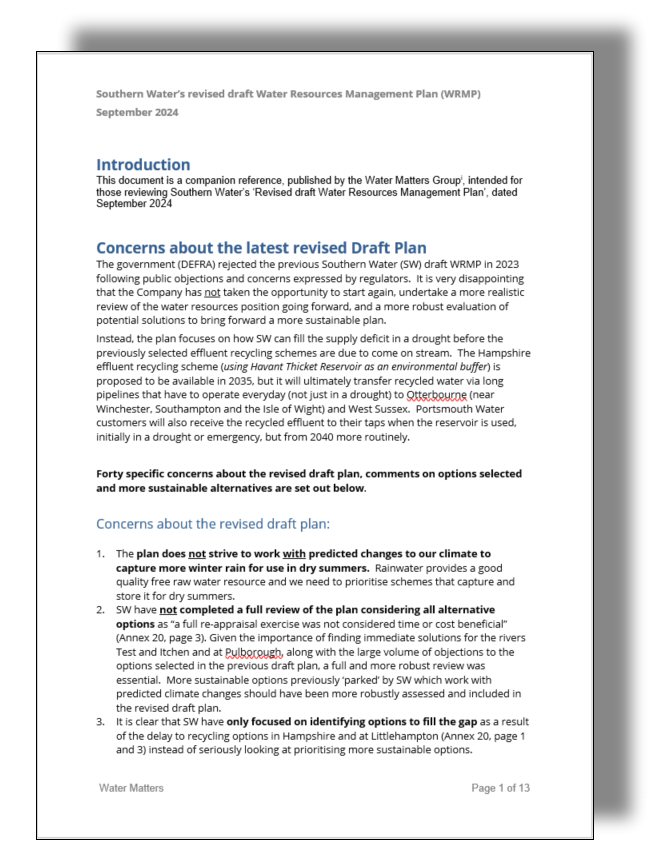
For a printable version of the contents of this page
Some readers may find it more convenient to open the content of this page as a downloadable and printable PDF file, including the softcopy links to all external documents. You can do this by clicking the image below:
Water Matters (Last updated 03/12/24)
 Havant Matters