The following frequently asked questions provide further detail and links relating to Southern Water’s Hampshire Water Transfer and Water Recycling Project consultation. To jump to the response to a particular question, simply click the appropriate line in this list:
- FAQ 1 – Will Portsmouth Water customers receive the recycled water? Yes
- FAQ 2 – What new infrastructure is being proposed?
- FAQ 3 – Is there a diagram showing which customers will receive the recycled effluent?
- FAQ 4 – Is a scheme which costs £1.2 billion best value?
- FAQ 5 – What are the concerns about selection of effluent recycling via Havant Thicket Reservoir to Otterbourne?
- FAQ 6 – What are the concerns about the location of the effluent recycling plant on the landfill at Broadmarsh, including the risks to Langstone Harbour & the Solent?
- FAQ 7 – What are the specific concerns about using the Havant Thicket Reservoir as an environmental buffer lake?
- FAQ 8 – What do we want to happen?
- FAQ 9 – What may be driving Southern Water to select effluent recycling?
- FAQ 10 – What other more proactive measures can be progressed to reduce the need for abstraction, including in a drought?
- FAQ 11 – Does effluent recycling reduce the risk of discharges from Budds Farm into Langstone Harbour? No
- FAQ 12 Are there more sustainable alternatives to effluent recycling?
- FAQ 13 – Do you have a list of the environmental concerns?
- FAQ 14 – Where exactly is ‘Site 72’, the location of the proposed Effluent Recycling Plant?
FAQ 1 – Will Portsmouth Water customers receive the recycled water? Yes
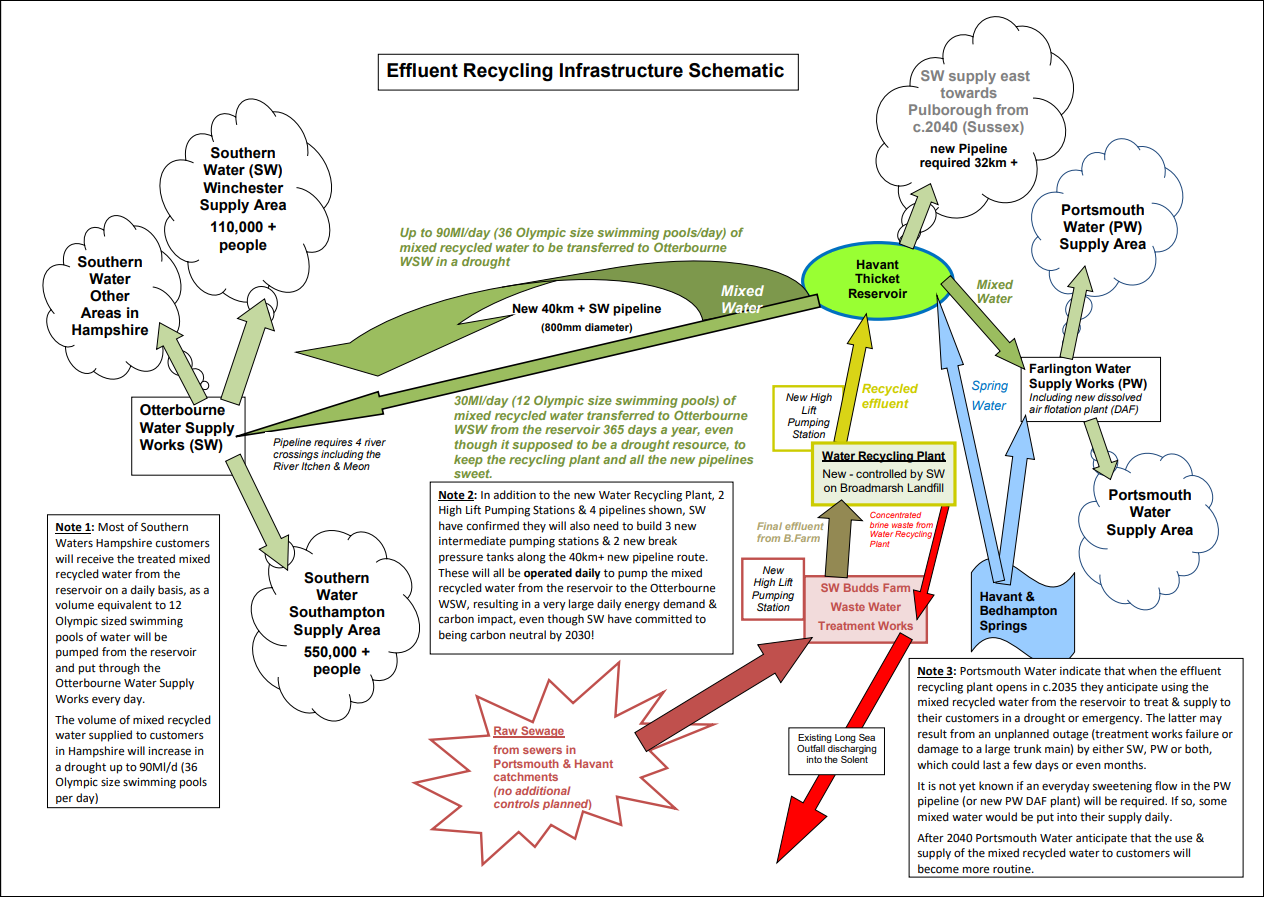
The following map from page 9 of the Southern Water Consultation Brochure is misleading as it shows no connection from the effluent recycling project to supply Portsmouth Water customers.
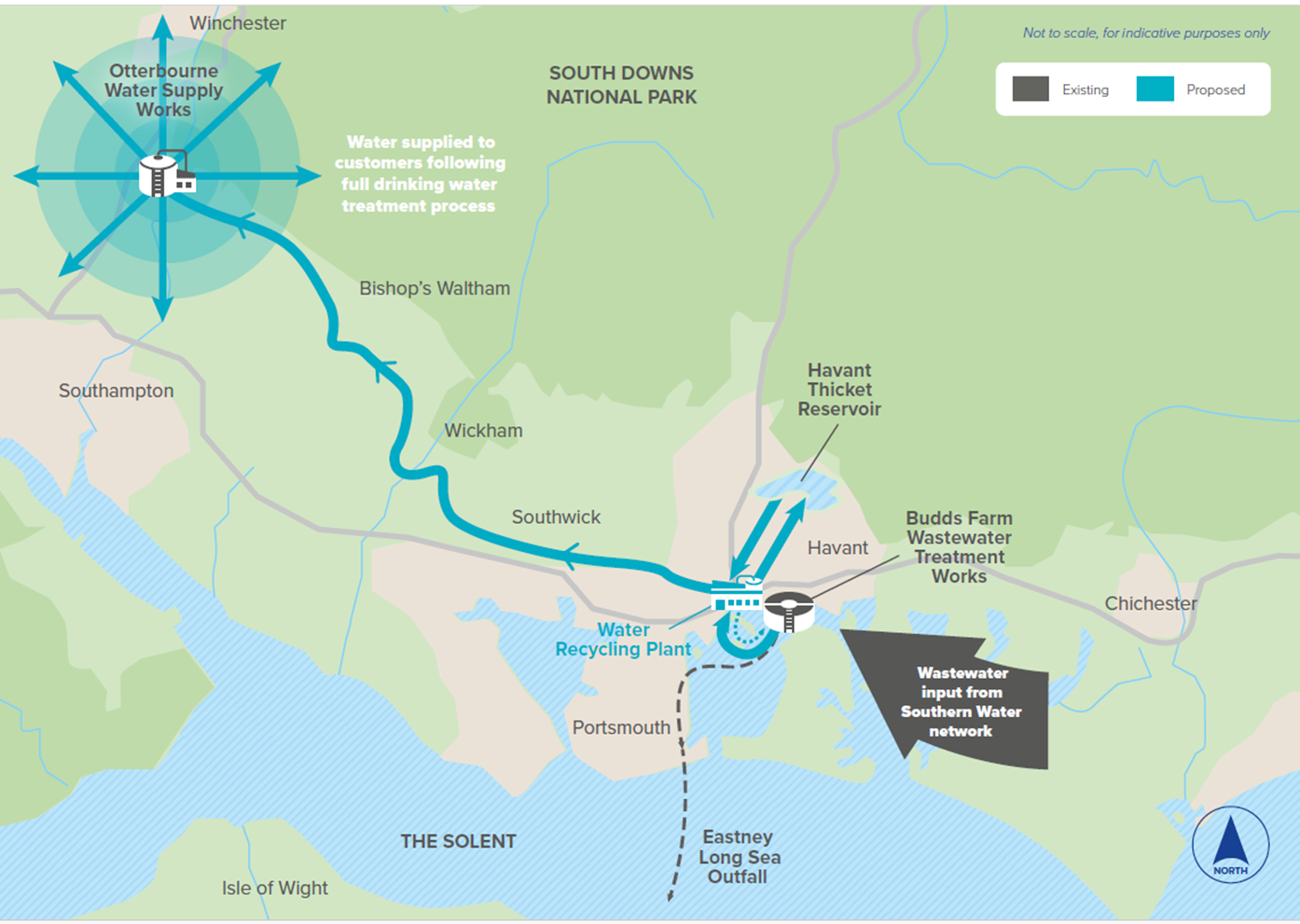
Despite the fact that Portsmouth Water customers will receive the mixed reservoir water from around 2035 in an emergency or drought situation when the scheme is complete, then from around 2040 they will receive the mixed reservoir water more routinely. Southern Water have confirmed that most customers in Hampshire will receive the recycled water.
The diagram is also missing the planned mixed water supply from the Havant Thicket Reservoir to Southern Water customers in Sussex from around 2040, including Midhurst, Pulborough, Billingshurst & Horsham.
The Portsmouth Water website confirms; If the Hampshire Water Transfer and Water Recycling Project is implemented, Portsmouth Water customers would receive a mixture of spring water and recycled water from Havant Thicket Reservoir in drought and emergency conditions – such as, if we, or Southern Water, were not able to use our regular sources of water due to an engineering or other issue. For example, the loss of a treatment works because of technical problems, or damage to a trunk water main that supplies many customers. (Reference, Portsmouth Water water recycling FAQs)
FAQ 2 – What new infrastructure is being proposed?
This map from page 17 of the Southern Water Consultation Brochure confirms the large amount of additional infrastructure needed for effluent recycling.
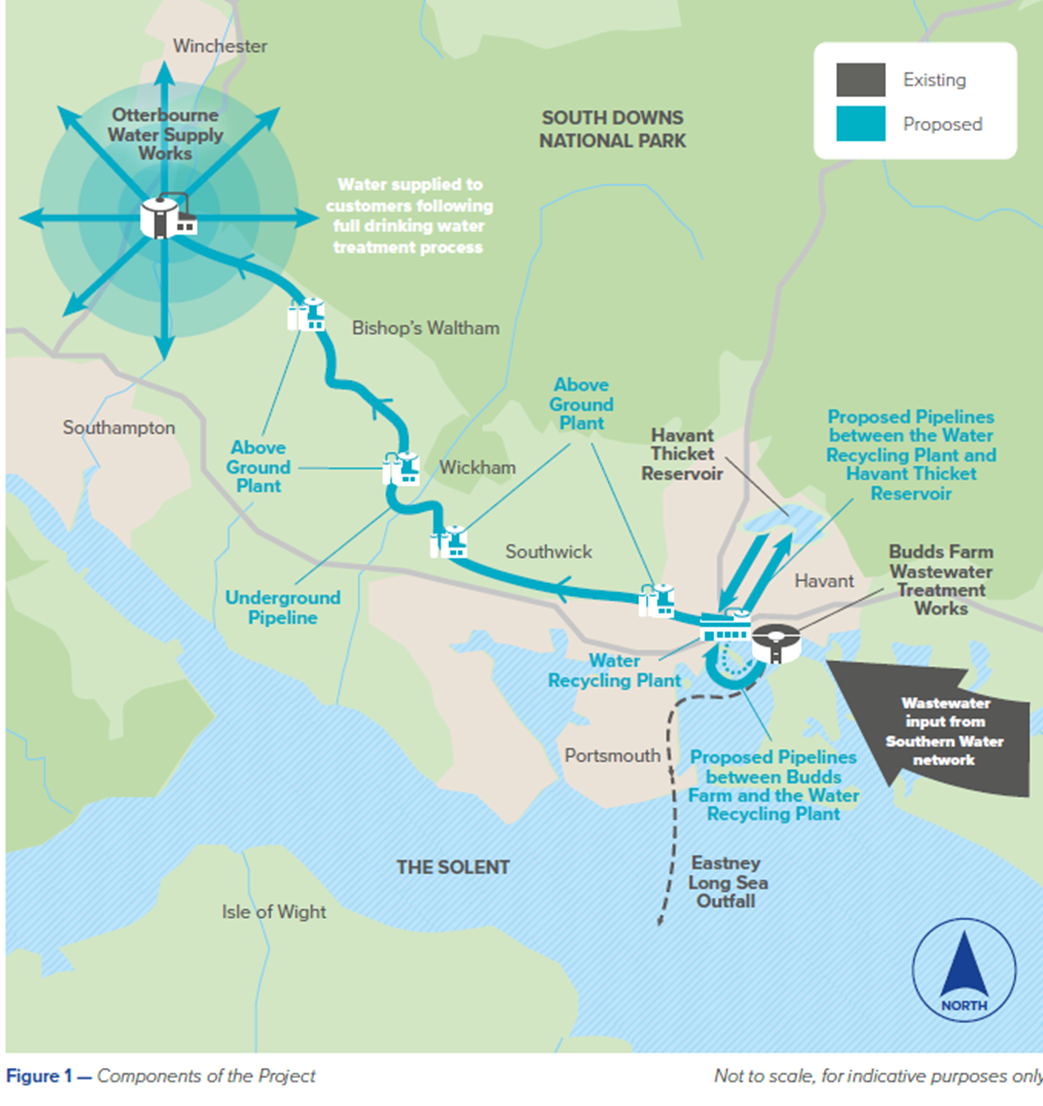
The company is allowed to make a profit from building the new infrastructure, which will include:
Large Water Recycling Plant (WRP)at Havant
40km pipeline to Otterbourne
2 new pipelines from Budds Farm to WRP
2 new pipelines to Bedhampton Springs or 2 new pipelines to Havant Thicket Reservoir
3 new pumping stations at Havant
In addition, for the pipeline between Havant and Otterbourne, there will be:
3 new pumping stations
2 new break pressure tanks
This project is supposed to be a drought resource which would only be needed in times of extreme water shortage. However, in order to maintain the equipment being constructed, the reality is that the plant and the pipelines will have to be kept running every day regardless of the actual demand. To maintain readiness for an emergency, in order to keep the pipes ‘sweet’ and the WRP filter membranes operational, Southern Water plan to treat, pump to the reservoir and then push on to Otterbourne, a volume of 30 ML (Megalitres) every day, even when it is not needed. That is the equivalent of 12 Olympic size pools of water a day.
Just think of all the energy, carbon and chemicals that will use every day. It is estimated the energy cost alone would be £3 million pounds per year in a normal year (i.e. not in a drought)
FAQ 3 – Is there a diagram showing which customers will receive the recycled effluent?
The following schematic diagram shows the full scope of the proposed project, as currently envisaged:
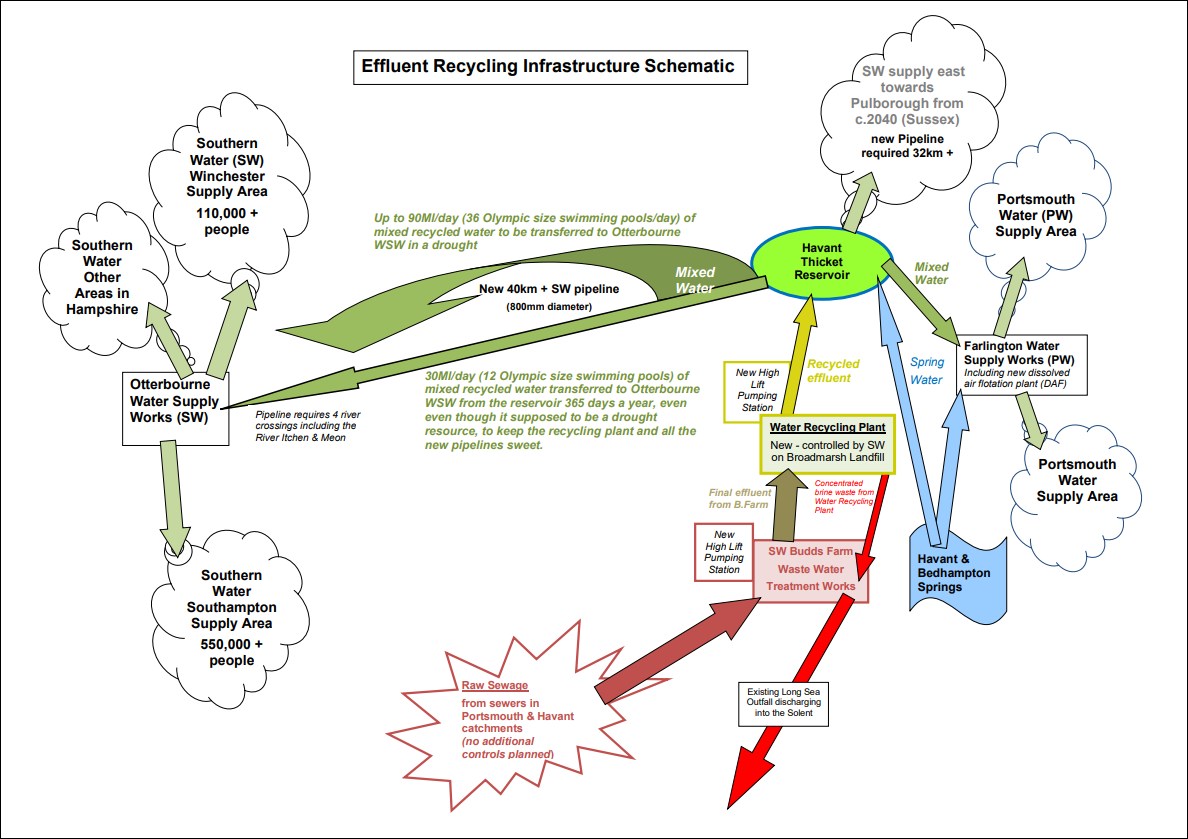
Here’s the same diagram with some addition detail notes.
FAQ 4 – Is a scheme which costs £1.2 billion best value?
The estimated cost for the effluent recycling scheme via Havant Thicket Reservoir is now £1.2 billion to 1.4 billion (not including the reservoir)
The costs are spiralling upwards, increasing by millions within a single year. The figure of £1.2 billion pounds was sourced from the Southern Water Communications Lead as the minimum cost for the effluent recycling scheme on the 15 June 2024. The same source caveated the statement with the comment that the overall cost could be £1.4 billion if the company have to build their own pipeline to the Havant Thicket Reservoir.
Costs for this scheme are rising rapidly, in June 2023 the estimated cost was £550-900 million, and the concern for customers is that the costs will continue to spiral, especially as the technology used for effluent recycling has not been used in the UK before.
Three new reservoirs the size of Havant Thicket could be built for £1.2 billion. The current estimated cost for the construction of the Havant Thicket Reservoir is £350 million. It’s important to recognise that money invested in effluent recycling decreases in value over a relatively short term since electrical & mechanical plant would need upgrades/ replacement every 10 to 20 years, with the plant coming to the end of its life in 60 years’ time. By comparison, more sustainable reservoir solutions would work with climate change collecting the forecast increased winter rainfall, and the reservoirs would still be functioning in 200 years time, providing better value for money and more environmental benefits, as well as potential in-combination benefits to reduce winter flooding risks.
The annual energy cost alone for the final effluent from the Budds Farm Sewage Works to be treated to drinking water standards is £2.6 million a year, a conservative estimate based on energy consumption and cost figures for the Havant & Otterbourne treatment plants provided by Southern Water. There will be additional significant treatment chemical, staff and maintenance costs for the effluent recycling plant too. With further substantial additional costs to replace the Reverse Osmosis membranes on a 5 to 7 year basis. These energy costs do not include any of the pumping costs to get the final effluent from Budds Farm Sewage Works to the Broadmarsh Water Recycling Plant, from the effluent recycling plant 4km to the reservoir, and the mixed water from the Havant Thicket Reservoir 40km+ to the Otterbourne water treatment works.
If these substantial extra energy costs are added the cost will exceed £3 million in a normal year (i.e. no drought). It is difficult to see how this can possibly be considered a ‘best value’ solution for customers, or for the environment given the huge annual carbon impacts.
The cost to Southern Water customers is around £2.50 per month over a 20 year period. That works out at an additional £30 per year on water supply customer bills just for the Havant effluent recycling scheme. There will then be significant additional increases to cover the costs of addressing sewage discharges, fixing supply leaks, and repairing/replacing aging Victorian sewage infrastructure.
It’s worth noting that money invested in effluent recycling decreases in value over a relatively short term since electrical & mechanical plant would need upgrades/ replacement every 10 to 20 years, with the plant coming to the end of its life in 60 years time. By comparison, a winter water storage solution such as a reservoir, works with climate change and will still be in there in 200 years time, providing better value for money and more environmental benefits, as well as potential in-combination benefits to reduce winter flooding risks.
Pursuing effluent recycling is a short-sighted water resource plan, customers will still be paying for the effluent recycling infrastructure after it has become redundant due to the Ofwat funding mechanism. With the recycling plants expected to last just 60 years, the huge cost of constructing these schemes cannot be justified, especially as these options leave no tangible legacy for the future. The Hampshire effluent recycling / transfer scheme alone will cost at least £1.2 billion. Customers will also have to pay for the eye-watering debt generated well into the future.
The Hampshire effluent recycling scheme alone will deliver a profit of about £45 million pounds to Southern Water, this kind of profiteering paid for by customers is not acceptable.
Is this the real reason that Southern Water have selected this expensive option?
Especially when more sustainable solutions would make them less profit?
The huge cost of servicing the massive debt created by the selection of such expensive options will also have to be paid for by customers.
FAQ 5 – What are the concerns about selection of effluent recycling via Havant Thicket Reservoir to Otterbourne?
The approach is not sustainable It is primarily a drought resource, yet it requires the daily use of lots of chemicals, energy and carbon for treatment and pumping. Southern Water (SW) plan to treat and pump more than 12 Olympic size swimming pools of water 40km+ every day of the year, even when the water is not needed.
The approach is contrary to Southern Water’s commitment for net zero carbon by 2030. This is bad for the planet and environmentally unsustainable. The company should be looking at existing, feasible and more sustainable options to help meet their target.
The approach is not supported by customers. 48% of people responding to the 2022 Consultation did not support effluent recycling, yet Southern Water have ploughed ahead regardless. Customers have been clear in all company and Water Resources South East research that they favour more natural solutions including; catchment solutions, aquifer storage and winter storage reservoirs.
The approach will encourage unacceptably high use of bottled water. Large numbers of people have said they will reject the water and turn to bottled water with all the environmental impact of that (transport, bottle waste and so on). It is a retrograde step to drive people away from tap water to bottled water and would echo public reaction to the supply of recycled effluent in California. In California and Singapore where water recycling is used many people have changed to using bottled water.
Incomplete appraisal of alternative options. There has been inadequate information provided by Southern Water to ensure that the options with the least likelihood of environmental impacts have been selected. By excluding the details relating to these options, the company is denying the detail required by a Habitat Regulations Assessment which would provide an accurate benchmark for the proposed solution.
Options with lower environmental impacts and lower costs have been ‘parked’ by Southern Water and the investigation needed deferred, ensuring the option cannot be selected. The scheme has proceeded through each RAPID gate process without adequate information on the environmental impacts and assessment of alternatives.
Environmental assessment undertaken was not robust. The early screening which allowed effluent recycling to be selected was at too high a level to understand the risks. How does the scheme which had the most negative impacts get selected? (highest score we found in short time Southern Water made available to view the restricted environmental assessment report at Worthing HQ)
Southern Water are putting all their eggs in one basket again for Hampshire & West Sussex, adopting a high-cost, high-impact monolithic solution instead of spreading the delivery risk across a number of more sustainable alternatives. The proposed approach carries a high risk of failure and further delays.
More environmentally friendly alternatives are not being brought forward for investigation, instead they are being ‘moth-balled’ until 2029.
FAQ 6 – What are the concerns about the location of the effluent recycling plant on the landfill at Broadmarsh, including the risks to Langstone Harbour & the Solent?
Impacts on the Solent
Significant concern about the impact of more concentrated reject water from the effluent recycling process being discharged in to the Solent via the existing Eastney Long Sea Outfall. The Southern Water assessment indicates a ‘likely significant effect’ in their Preliminary Environmental Information Report published with the consultation. They indicated that they are undertaking further modelling.
The reject water discharge to the Solent is likely to most concentrated in a drought scenario, when the maximum volume of reject water is being produced (20Ml/day), at the same time as the flow of final effluent from B. Farm to mix with it in the long sea outfall is at its lowest, as 80Ml/day of final effluent is being diverted to the Water Recycling Plant (WRP) for effluent recycling, meaning there will be less waste water from the normal Budds Farm treatment process to dilute the WRP reject water coming out of the Long Sea Outfall.
Note: There is also the potential for the additional solid waste from the Water Recycling Plant to be put back into the Budds Farm works, if this is to be the case the impacts of this need to be considered in the modelling for the revised discharges for the Long Sea Outfall.
Impacts on Langstone Harbour
Very significant risks associated with developing the effluent recycling plant and the high lift pumping station on the Broadmarsh ‘dilute and disperse’ landfill. This landfill site was in daily use through the late 1960s to the 1980s with no lining over the harbour muds. Domestic, commercial and industrial waste was tipped here, including incinerator ash. The fill material contains solvents and hydrocarbons which are easily mobilised in groundwater. Domestic, commercial and industrial waste was tipped here, including incinerator ash. The fill material contains solvents and hydrocarbons which are easily mobilised in groundwater.
The Southern Water 2022 Consultation findings confirmed that 41% of respondents did not support the selection of the landfill site at Broadmarsh for the recycling plant.
The Alternatives Assessment should also consider an alternative site for the Water Recycling Plant in Fareham, away from the coast. In that alternative, the initial source of sewage effluent for recycling would be taken from Peel Common Wastewater Treatment Works, with later construction of a pipeline from Budds Farm WWTW if a greater volume deemed necessary. No plant construction would then be needed at Broadmarsh and the environmental risks would be significantly reduced. This would be a more sustainable solution as the plant would be closer to where the recycled water is actually needed in Southampton and Winchester. There could potentially also be benefits of less sewage going into the centre of the Solent on a daily basis where there is less circulation.
There will be a significant risk of leachate and landfill gas being mobilised by piling and tunnelling through the waste into the chalk aquifer below – groundwater flow in the aquifer is to the south (i.e. flowing towards Langstone Harbour).
Construction impacts on Special Protection Area (SPA) and loss of Brent Goose and Wader Site. The long construction period will mean that risk cannot be controlled by the timing of the works.
Risks associated with pipeline construction below the Hermitage Stream and added risk of future pipeline leaks/ maintenance activities. How can the pipeline be sealed to prevent leachate from the landfill migrating along the pipe or tunnel below the stream?
Surveys and assessments cannot fully identify and mitigate the risk from the landfill. The alternative site assessment has not been adequate, underplaying the risks of developing on the landfill. Other sites have been identified with less risk but these have been dismissed. The information on site assessment that has been provided for public view is too vague.
FAQ 7 – What are the specific concerns about using the Havant Thicket Reservoir as an environmental buffer lake?
The proposed hybrid operation of the Havant Thicket Reservoir destroys the previous unique biodiversity opportunity to a chalk spring-fed reservoir.
Significant additional risk of pollution from the recycling plant, especially if it is not maintained properly by Southern Water.
Despite the complexity of the new treatment process, which is new to the UK, and the risks to the reservoir if Southern Water fail to maintain the treatment plant, no independent monitoring is proposed.
There are significant changes in water composition (salinity, temperature, geochemistry) and risk of bioaccumulation, which could all impact the ecology. Very rapid changes in water composition would occur in the event of a drought. What impact will this have on the reservoir ecology?
– Up to 24 Olympic size pools of recycled effluent in and 36 Olympic size pools of reservoir water out per day.
There is no robust Habitats Regulation Assessment, significant since the design as proposed should fail a robust assessment.
– Not considered all of the potential effects on European protected sites. For example, changes in water quality via stream compensation flow to the harbour under different filling regimes, and emergency drawdown and testing impacts not considered. Water quality modelling is not yet complete yet Southern Water are pressing ahead with the scheme.
– Not properly considered in-combination effects, with the original spring-fed reservoir proposal and Sandown effluent recycling option . Initial coastal modelling was not robust. Not clear if the nitrate benefits the original spring fed reservoir would provide to the harbour will be maintained under all new operating scenarios involving the use of recycled water. Reservoir water quality modelling not yet completed, yet Southern Water is pressing ahead.
Loss of promised benefits that enabled Natural England, Havant Borough Council as the local planning authority, and other stakeholders to support the original reservoir scheme which included the loss of 12.5 hectares of ancient woodland and protected species habitats.
– Potentially reduced biodiversity net gain; previous risk of eutrophication and algal blooms in spring fed reservoir was low, but may now increase.
– There could be less nitrate reduction to European protected harbour(s) – less spring water used to fill the reservoir each autumn as Southern Water state that the reservoir will be kept topped up using recycled effluent (the modelling being undertaken needs to include the full range of operational scenarios from the baseline/normal scenario, as well as varying drawdown / topping up scenarios. The outcomes then need to be compared to the original spring fed reservoir operating scenarios as an in-combination effect). Any loss in nitrate benefit is not acceptable.
FAQ 8 – What do we want to happen?
Rejection of site 72 on the Broadmarsh landfill. If effluent recycling is to go ahead an alternative site must be used for the plant and tunnel shafts. There are alternative sites available.
Southern Water should be developing more sustainable alternative water resources that work with climate change, not against it. Making use of the predicted wetter winters to store more water for drier summers, which would reduce the pressure on rivers.
Move the Otterbourne abstraction close to the tidal limit, protecting the whole of the upstream River Itchen catchment from droughts.
Move existing borehole abstractions further down the catchments to reduce their environmental impact.
Proactively investigate and develop new winter storage in confined underground aquifers. Note; No schemes selected by Southern Water 2025 to 2035, but they could offer a quicker, simpler solution to benefit our chalk streams, relieving the pressure for river abstraction in summer. For example, bringing forward the Test aquifer storage scheme from 2041/42.
Note: Southern Water have identified lots of potential aquifer storage schemes that have effectively been ‘parked’ – How do we ensure these options are investigated and brought forward?
Proactively investigate and develop new winter storage reservoirs. Note; First scheme selected by Southern Water is the River Adur off-line reservoir in 2045. There are likely to be other options which are not being assessed. For example, for winter storage from the River Wallington and River Hamble. You could build three winter storage reservoirs for the cost of this effluent recycling scheme.
Amending abstraction licences to allow more water to be taken in the winter and less in the summer. This would encourage Southern Water to investigate and develop more sustainable, cheaper, winter storage schemes to be developed.
We are concerned that cheaper and more sustainable schemes are not being proactively identified and investigated to enable selection, ensuring that effluent recycling is left as the only option. As a minimum there should be a twin track approach, investigating and developing more sustainable solutions in tandem.
Note; If effluent recycling is to be taken forward all customers who will receive the water should be consulted directly to get their opinion.
There needs to be urgent Government action to speed up the introduction of new Building Regulations & introduction of minimum standards for products that use water (e.g. dishwashers). Plus allowing the use of variable tariffs so that those who use the most water pay more.
FAQ 9 – What may be driving Southern Water to select effluent recycling?
The last two winters have shown that we get plenty of rain, the water companies just need to develop more solutions to store it. The UK is not a drought stricken region which has no option but to recycle effluent, so why are Southern Water pursuing effluent recycling?
The funding mechanism drivers urgently need to be changed by Ofwat.
There is real concern that rejection and selection of water resource options is being driven by the search for profit, as the current funding mechanism incentivises water companies to develop infrastructure heavy solutions like effluent recycling, which allow them to make more profit, rather than developing more sustainable solutions.
There is a concern that Southern Water are keen to rush through very large infrastructure schemes in the current plan period to maximise their profit before the funding mechanism is changed by Ofwat.
The Hampshire effluent recycling scheme alone will deliver a profit of about £45 million pounds to Southern Water, this kind of profiteering paid for by customers is not acceptable.
The huge cost of servicing the massive debt created by the selection of such expensive options will also have to be paid for by customers.
Concern that the forecast population figures used to estimate the volume of water needed are excessive and driving a large demand deficit that may not materialise in the timescales predicted.
Lack of public consultation to enable a more informed choice; The publicity for the consultations about this fundamental change to the source of our drinking water supplies has been extremely poor, with most Southern Water and Portsmouth Water customers unaware of Southern Waters’ plans for effluent recycling.
When Southern Water changed their plan from desalination to effluent recycling they did not carry out a full review of all of the alternative options, nor did they undertake a statutory consultation.
Posters were not placed at locations where the infrastructure will be sited during previous consultations.
There has been no direct mailing of customers or information supplied with bills. In fact, Southern Water have confirmed they have no plans to notify all customers about their plans, or to notify them about future consultations. Yet case studies from drought stricken countries emphasise the need to get customers on board.
Why not recycle sewage from works closer to where the water is actually needed near Southampton instead of pumping it more than 40km? That could provide a more environmentally friendly solution if effluent recycling were the only option.
Money invested in effluent recycling now becomes redundant when the plant comes to the end of its life in in approximately 60 years time, with upgrades/ replacement of electrical & mechanical plant needed every 10 to 20 years. Whereas a winter water storage solution, such as a reservoir, works with climate change and will still be in there in 200 years time, providing better value for money and more environmental benefits, as well as potential in-combination benefits to reduce winter flooding.
The estimated cost for effluent recycling scheme via Havant Thicket Reservoir is now £1.2 to 1.4 billion (not including the cost of the reservoir) with costs spiralling. This is of no concern to Southern Water as costs are passed onto customers.
FAQ 10 – What other more proactive measures can be progressed to reduce the need for abstraction, including in a drought?
A much more proactive programme of mains renewal is needed. Current circa 1000 year renewal rate means that Southern Water will never get leakage under control – water mains are only designed to last 100 to 120 years.
Not reducing the frequency of ‘hosepipe bans’ (TUBs – temporary use bans) as was proposed from 2030, even though drought orders will still be in use. This sends out completely the wrong message to customers and there is no driver as customers are content with the current level of service. Reduces the need to abstract 4.01Ml/d of river water from 2030.
Working to reduce non-household use. Including with schools, community centres, churches and other public buildings. This could also help with public education/messaging.
Working with farmers and large commercial users to reduce consumption, develop alternatives, including collecting and storing more winter rain.
Pressing the government to speed up the introduction of new minimum standards for all water-using products (2030, not 2040), and introducing new Building Regulations (2040 at the latest, not 2060 as planned). WRSE states this would save 300 Ml/day and reduce water use to 109 litres/day.
Introducing a system of variable tariffs for water charging above a baseline volume. Political support needed to make this happen.
Investigate water neutrality for new developments, including off-setting by improving water efficiency in existing properties. (As is currently being used in parts of Sussex).
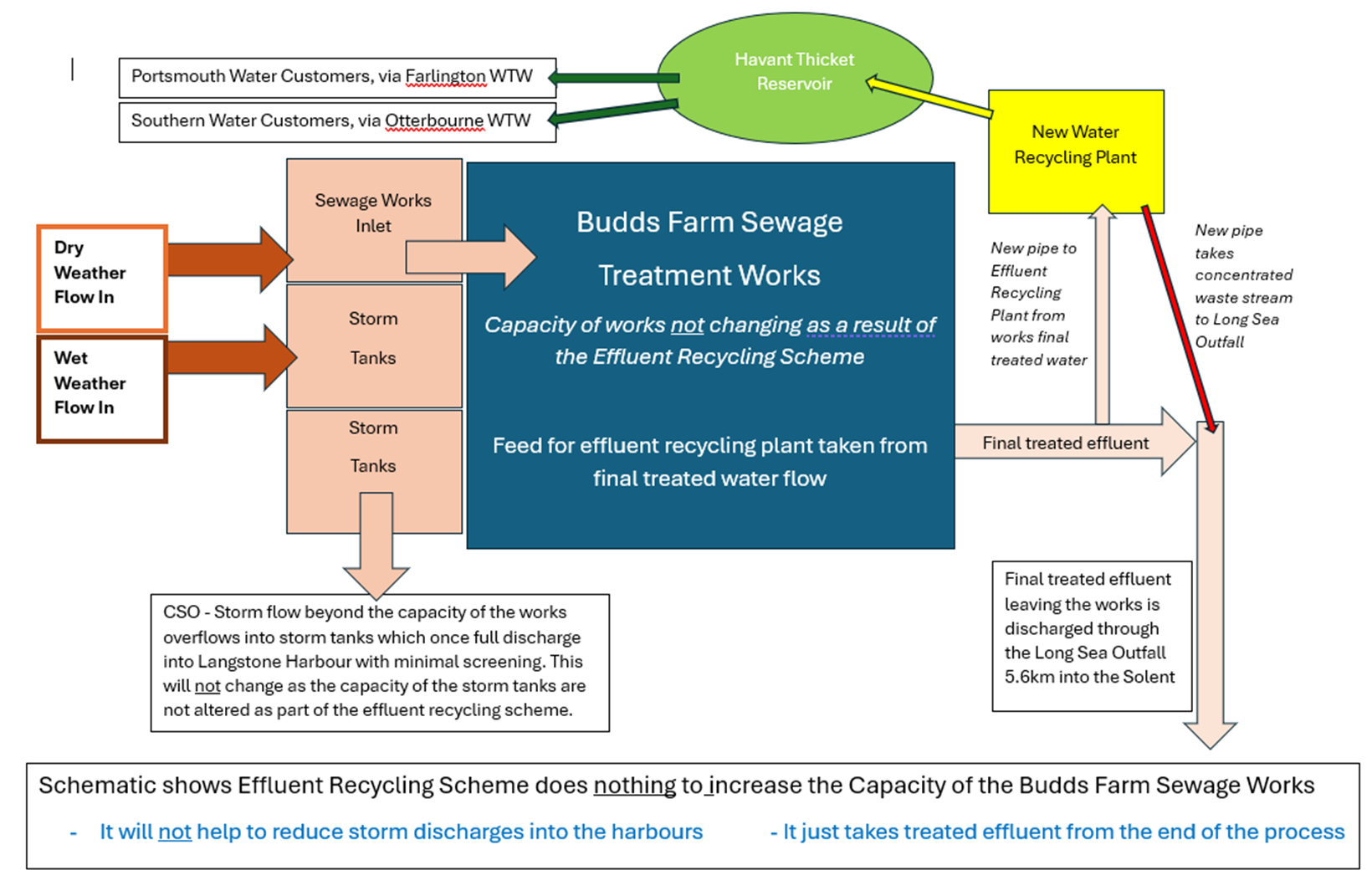
FAQ 11 – Does effluent recycling reduce the risk of discharges from Budds Farm into Langstone Harbour? No
FAQ 12 Are there more sustainable alternatives to effluent recycling?
In short, yes there are. For a detailed understanding of the alternatives, please refer to this page.
FAQ 13 – Do you have a list of the environmental concerns?
The environmental concerns with respect to recycling final effluent from Budds Farm sewage works to a new treatment plant on the landfill at Broadmarsh (Havant), using Havant Thicket Reservoir as an environmental buffer lake for storage, and then transporting the water more than 40km to the Otterbourne treatments works are many and varied.
- Detrimental impacts on Langstone Harbour;
- Risks from landfill leachate
- Impact on special interest features of the Special Protection Area (including Brent Geese & waders)
- Visibility impacts around Langstone Harbour
- Potential loss of nitrate benefit expected in Langstone Harbour
- Detrimental impact on the Solent from discharge of concentrated reject water
- Huge energy & chemical use, even when there is not a drought
- Enormous carbon impact during construction and operation
- Environmental impacts on Havant Thicket Reservoir;
- Increased risk of pollution to the reservoir
- Changes to temperature, salinity and loss of a unique opportunity to create a chalk spring fed reservoir
- Impact of rapid changes in water composition
- Risk of turning people away from tap water which could result in unacceptably high use of bottled water, creating a new plastic waste problem
- Adverse environmental impacts associated with plant & pipeline construction
- Effluent recycling is not a sustainable solution
- Environmental assessment undertaken was not robust
- Effluent recycling should fail a robust Habitats Regulation Assessment
- No proposal to improve discharge consents on industrial discharges into the sewers
Further information is provided on each of these environmental concerns on a separate page.
Please take this link to review the Environmental Concerns.
FAQ 14 – Where exactly is ‘Site 72’, the location of the proposed Effluent Recycling Plant?
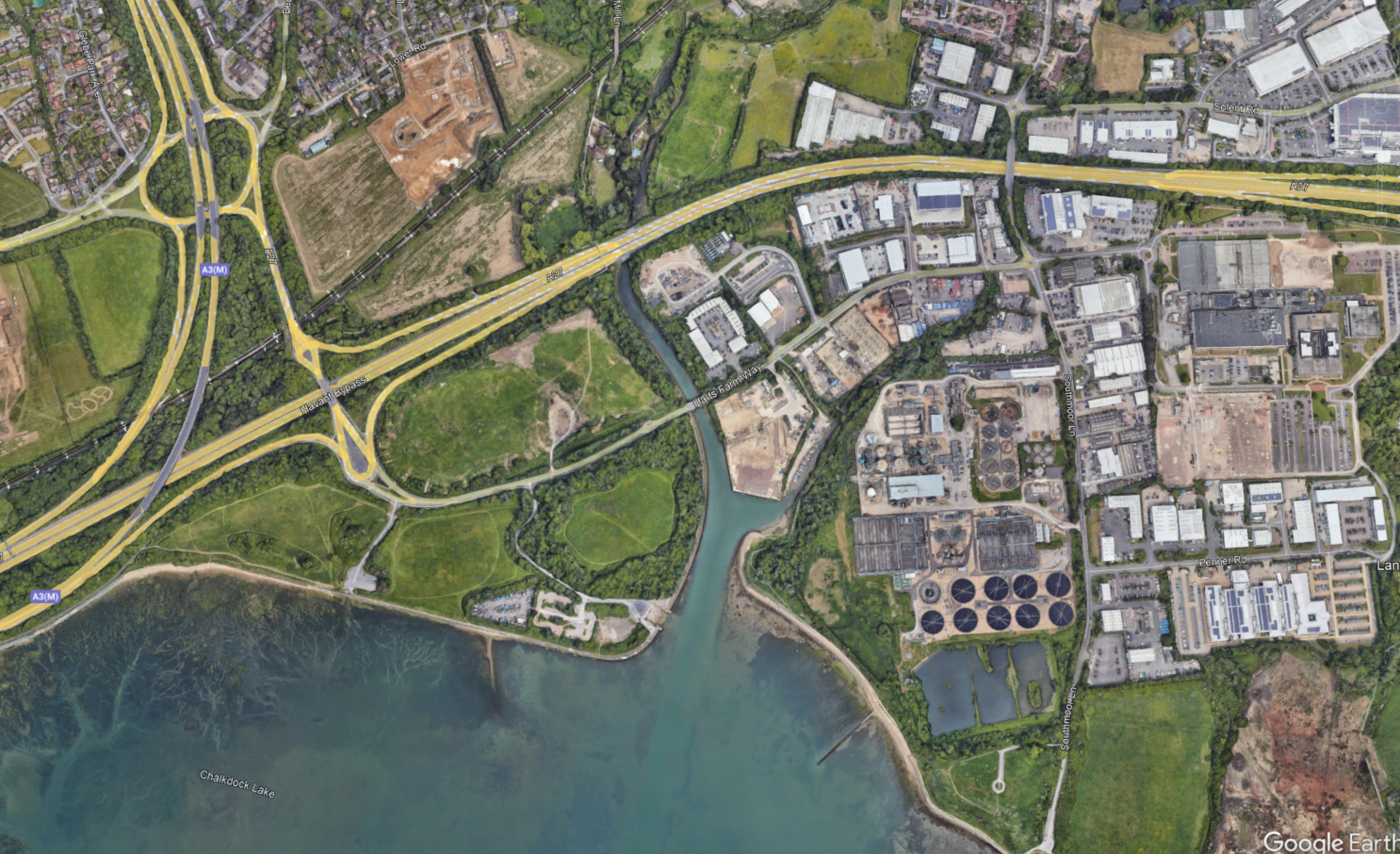
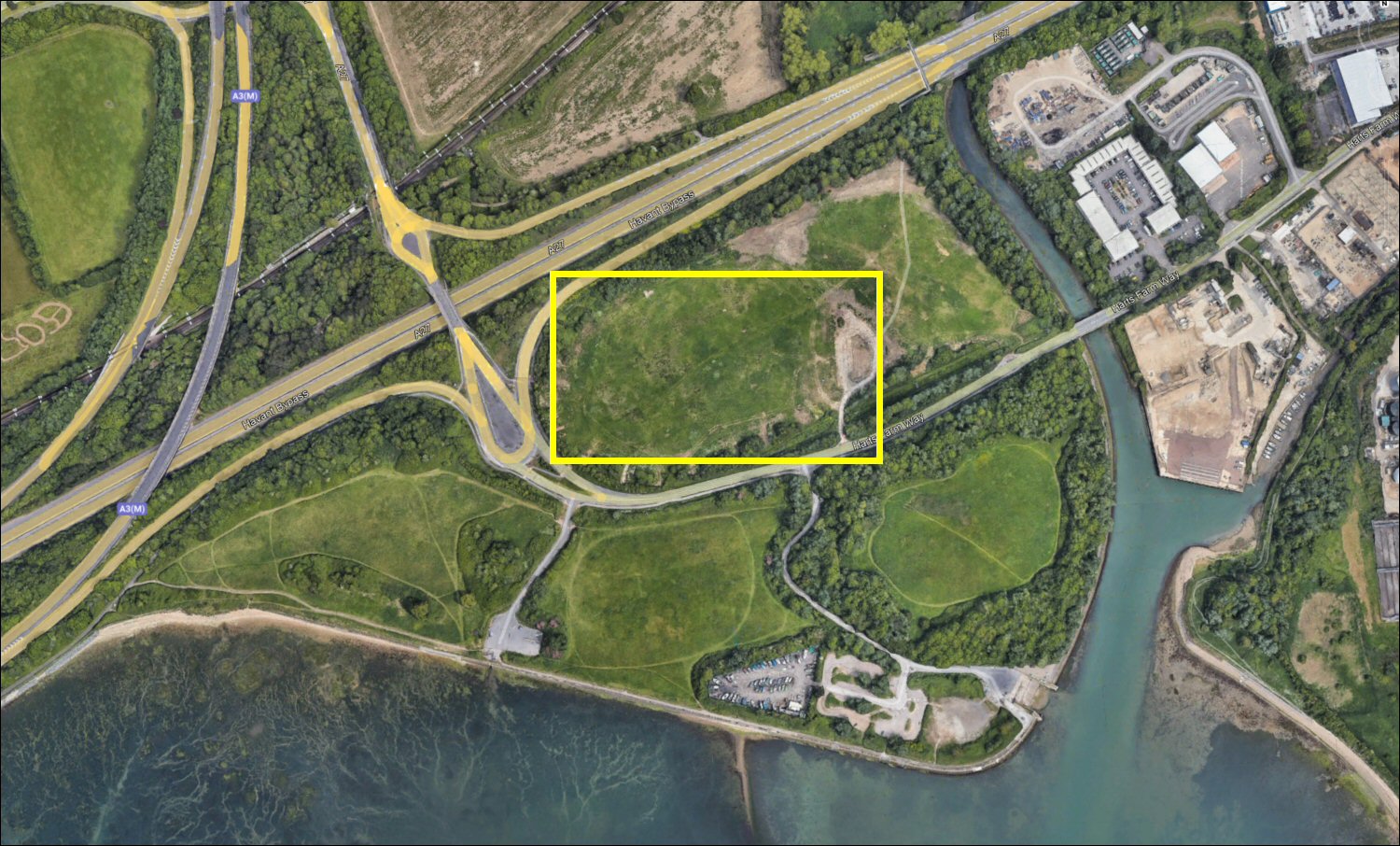
The site selected for the Effluent Recycling Plant is between Harts Farm Way and the A27, on the northern shore of Langstone Harbour, shown by the yellow rectangle in the slide below:
[Last updated, 25-11-2024]
 Havant Matters