Respond to the consultation before
4 December 2024
Write to / email DEFRA to object to the plan and insist that Southern Water develops a more sustainable plan that puts local people and the environment before profit.
We only collect 1% of rainwater in the UK. This is a once in a generation opportunity to change the way we supply water by investing in sustainable solutions that work with climate change, not against, like collecting and storing more water in aquifers and reservoirs, plus moving existing abstractions to reduce their impact on our precious rivers.
It is shocking that 19% of the water that customers have paid to treat is lost by leakage in the Southern Water distribution network, that’s 100 million litres of precious water lost every day. Demand Southern Water do more on leakage and renewal of their water mains.
The Hampshire effluent recycling scheme alone will deliver a profit of about £45 million to Southern Water, this kind of profiteering paid for by customers is not acceptable.
Click here to find out about 5 major concerns with Southern Water’s draft plan
Water industry research shows that customers prefer more natural solutions such as reservoirs and aquifer storage, which are also cheaper, but Southern Water have not listened and are charging ahead with effluent recycling schemes without first understanding the environmental impacts.
It is not too late to make a difference. Please read about the concerns and respond to the consultation.
| The Top 5 concerns about the WRMP | This page summarises 5 major concerns with Southern Water’s draft plan |
| The 15 detailed concerns about effluent recycling detail | This page draws out 15 bite-sized concerns, cross referencing them with further detail provided by the FAQs |
| The 40 detailed concerns about the Southern Water plan | This page takes a deeper look at a wider list of concerns raised by the content of the WRMP |
With the publication of Southern Water’s Draft Water Resources Management Plan, now available for public comment until 4 December 2024, it is clear that many of the concerns raised and documented on this site also apply to similar effluent recycling plants proposed for development at Sandown on the Isle of Wight and at Littlehampton in West Sussex.
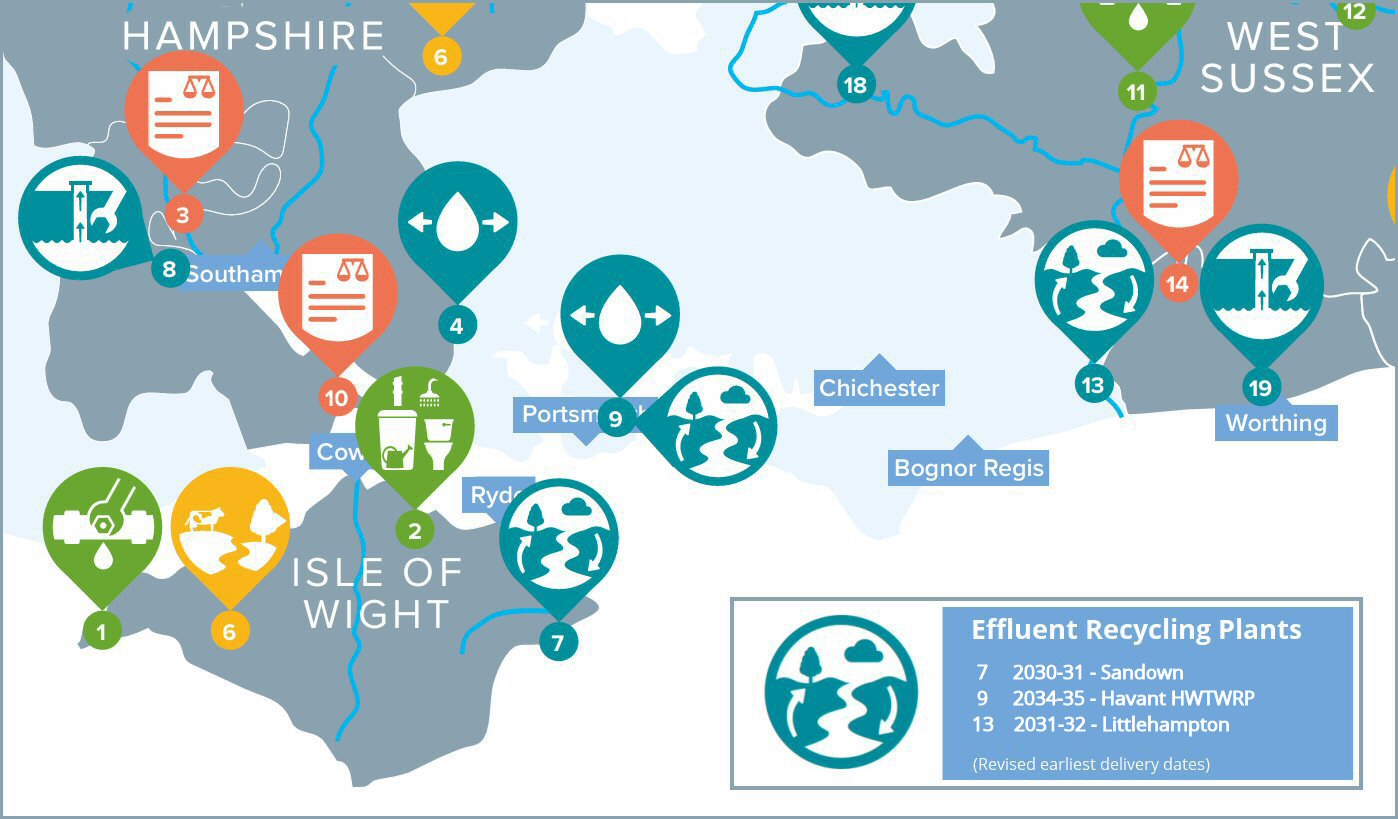
Effluent recycling using Reverse Osmosis has not been used in the UK before for public water supply. The three proposed new effluent recycling plants will use processes including reverse osmosis filtering to provide an additional level of treatment to the output from the local wastewater treatment works. In the case of Sandown WWTW and Littlehampton (Ford WWTW), the recycled effluent will then be discharged for ‘environmental balancing’ into the Eastern Yar and Western Rother rivers respectively, with an equivalent volume of freshwater being abstracted further downstream.
For Budds Farm WWTW at Havant, the discharge arrangements are rather more complicated since Southern Water are proposing to hijack Portsmouth Water’s Havant Thicket Reservoir (HTR – currently under construction) for use as an environmental buffer lake. A volume of 12 Olympic size swimming pools (30Ml/day) of recycled effluent will be pumped to the reservoir everyday, with an equivalent volume of mixed water from the reservoir then being moved via a new 40+km pipeline from Havant to Otterbourne Water Supply Works near Winchester, for final treatment into the Southern Water supply network.
There is significant opposition to Southern Water’s proposed use of the HTR given that Portsmouth Water’s customers will then also receive the mixed water, and the Local Planning Authority consent for construction and operation is conditional on the reservoir being filled with ‘raw water’ sourced from the company’s local chalk-fed freshwater springs.
The Budds Farm and Sandown effluent recycling plants are proposed for construction on former landfill sites which, in the case of Havant, gives rise to significant environmental risks / concerns documented elsewhere on this site.
All three effluent recycling plants would generate a reject stream of up to 25% of the throughput as a concentrated warm brine which would be discharged offshore into the marine environment via the existing Southern Water Eastney, Sandown and Littlehampton long sea outfall (LSO) pipes. Concerns about the discharge from the Eastney LSO are detailed within these pages.
It is important for communities across Hampshire, Sussex and the Isle of Wight to appreciate that, while these three effluent recycling plants are documented for use as a ‘drought resource‘, all three plants, which will require huge amounts of energy, will have to operate year round, even when the water is not needed, in order to maintain the ‘sweetening flow’ needed to keep the pumps, pipelines and membrane filters in good working order. Regular filter cleaning will result in concentrated filtrate solids being discharged from the membranes. Where these ‘solids’ will go is not yet clear, though it is likely that they will be fed back into the waste stream at the sewage works.
It is also important to note that Southern Water consider all three of these effluent recycling plants to be ‘Nationally Significant Infrastructure Projects‘ and will bypass Local Planning Authority process by applying directly to the Planning Inspectorate for Development Consent Orders.
| Site page summary for Effluent Recycling | |
|---|---|
| Key concerns (In summary) | A summary of the key concerns being raised by the community campaigners and find out how to respond to the consultation. This page contains a cross reference between the Key Concerns and further detail provided in the Frequently Asked Questions page. |
| Environmental Concerns (In detail) | Puts the focus on the many environmental concerns which have been raised by the HWTWRP project proposal. |
| The Alternative Options | Provides in depth discussion of the alternative water supply options which have been ‘discounted’ by Southern Water in its selection of the Effluent Recycling approach. |
| A Better Way Forward | An overview of a better and more sustainable way forward. |
| Frequently Asked Questions | Contains detailed supporting information relating to a number of commonly asked questions. |
| Have Your Say | The links and details you need to respond to the Southern Water WRMP consultation. |
The Water Matters group is an association of residents’ associations, environmental groups, individual residents, their elected representatives and other interested Southern Water and Portsmouth Water customers and consumers.
Content published by Havant Climate Alliance and Havant Friends of the Earth.
[Last updated, 20-10-2024]
 Havant Matters